
The Empty Seatback Pocket
A belated eulogy for the seatback pocket, the Brookstone massage chair, and the 147-pound garden yeti.

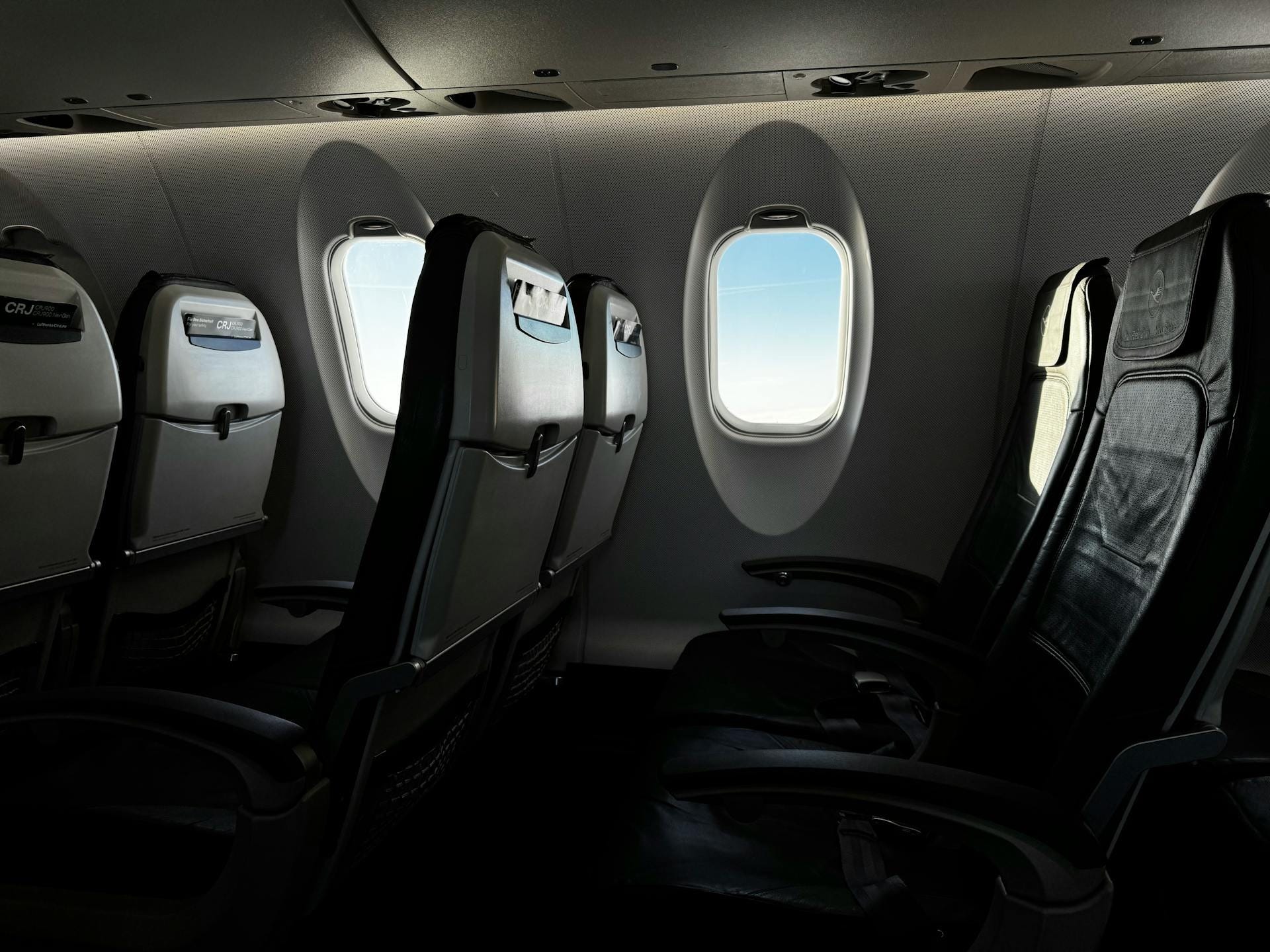
The seatback pocket on a United Express ERJ-145 holds three things. A safety card, a barf bag, and a void where SkyMall used to live.
I inventoried it on April 2nd, somewhere over West Virginia, with a phone at nine percent and no way to reach my backpack in the overhead bin. Bulkhead seat. Tiny commuter jet. Huntsville to Dulles. Ninety minutes of air between me and an Uber that my dying phone might not live long enough to summon. I had my AirPods, my dwindling battery, and an amount of unstructured time that felt, frankly, anxious.
So I reached into the seatback pocket the way you reach for a light switch in a room you haven’t visited in years. Muscle memory. The hand knows what used to be there.
SkyMall, the in-flight catalog that once reached 650 million passengers a year, filed for Chapter 11 bankruptcy in 2015. From a $33.7 million business to a fire sale in eighteen months. I can still see the garden yeti (you probably can too). SkyMall’s all-time best seller. A 147-pound resin Bigfoot statue, $2,000 for the life-size model, over 20,000 units shipped to people who made the decision to buy a yeti at cruising altitude.
I sat there with my now eight percent battery and an empty seatback pocket. A full moon rose outside the window. Enormous. April full moon, bright enough to light the ridgeline below (I imagined it was the National Radio Quiet Zone). I watched it climb for a while and thought about the Artemis II crew, looking at the same moon getting bigger from whatever angle astronauts get on their way to Luna. For maybe forty-five seconds my brain did something it hasn’t done in a while. It wandered somewhere I didn’t send it.
Then I turned on a podcast because I couldn’t handle the boredom, and accepted that my phone might die before Dulles.
That gap between the moonrise and the podcast is what this piece is about. The forty-five seconds of undirected attention I couldn’t sustain. The seatback pocket that used to fill that gap with a 147-pound yeti and a garden gnome collection I coveted as a child. That catalog and the boredom it once served are gone.
The Garden Yeti Economy
SkyMall was a boredom business, and boredom business was good until October 2013.
That’s when the FAA announced that airlines could let passengers use portable electronic devices gate-to-gate. JetBlue implemented the policy the next day. A flight from New York to Buffalo became the first commercial flight where you could stare at your phone from pushback to parking brake, and the clock started ticking on every business model that depended on your inability to do exactly that.
SkyMall’s revenue dropped from $33.7 million in 2013 to $15.8 million in the first nine months of 2014. Delta and Southwest terminated their contracts. Fifteen months after the FAA ruling, SkyMall was bankrupt. The causal line is clean enough to diagram on a napkin. The FAA gave passengers their phones, passengers stopped flipping through catalogs, and a company that existed because people had nothing to do at 35,000 feet discovered that people now had something to do at 35,000 feet.
But calling SkyMall a catalog misses what the catalog actually was. The Smithsonian ran a piece after the bankruptcy titled “How SkyMall Captured a Moment of Technological and American History.” SkyMall captured the moment when 650 million people a year, crammed into aluminum tubes, had nothing to do except flip through the same pages of the same absurd merchandise and experience the same collective bewilderment.
You and 14C were looking at the same yeti. You and the entire plane were occupying the same pocket of idle time, browsing the same weird stuff, having the same quiet internal conversation about whether anyone, anywhere, had ever actually ordered the SkyRest Travel Pillow and RF-blocking Mesh Metal Wallet.
(Someone had. Thousands of someones had. That was the magic.)
Brookstone and the Infrastructure of Idle Discovery
SkyMall died alongside an entire ecosystem of places that existed because people had time to kill and nothing specific to do with it.
My dad and I used to go to Brookstone at the MarketFair mall outside Princeton. I was five, maybe six, the first time. We went back for years. The ritual was to sit in every massage chair, use every massage wand, play with the small robots, ogle at the colorful watchamacallits, tinker with the noisy thingamajiggies, and buy nothing. I saw my first drone at that Brookstone, probably around 2004, a little counter-rotored helicopter thing on a shelf that felt like science fiction. We didn’t buy it. We stood there and imagined what you’d do with it.
That was the whole point. Brookstone was a store you visited to experience objects you’d never own. The browsing was the product. The idle wondering, the tactile exploration, the “what would I even do with this?” conversation between a kid and his dad on a Saturday afternoon. That was what Brookstone sold. Time spent noticing things for no reason.
Brookstone filed for bankruptcy in August 2018 and closed all 101 mall stores. Same cause of death as SkyMall. Shoppers found everything online. Sharper Image preceded them both, filing in 2008, closing 183 stores. Revenue had peaked at $760 million in 2007. By 2009, the massage chairs sat in empty storefronts with LEASE AVAILABLE signs taped to the glass.
Three companies, three bankruptcies, three versions of the same obituary. A business that depended on people wandering in with no agenda got killed when people stopped wandering.
What replaced the wandering was scrolling.
Seven Hours and Three Minutes
The average American adult spends 7 hours and 3 minutes a day on screens. Smartphones account for 5 hours and 16 minutes of that, up 14% year over year. For teenagers, 41% exceed 8 hours daily.
Seven hours and three minutes is more time than most people sleep. It is roughly the length of a transatlantic flight, except a transatlantic flight has a destination.
Linda Stone, a former Apple and Microsoft executive, coined a term for this in the nineties. “Continuous partial attention.” Stone described it as “an always-on, anywhere, anytime behavior that involves an artificial sense of constant crisis.” Twenty-eight years later, her description reads like prophecy.
The pull-to-refresh gesture on your phone mimics a slot machine lever, complete with a (deliberate) moment of suspense before the new content loads. Notification badges exploit the Zeigarnik effect (the psychological discomfort of unresolved tasks... you can turn these off by the way). Your brain releases dopamine in anticipation of the notification. The red badge fires before you know what it contains. Variable reward, the most powerful reinforcement schedule in behavioral psychology, is the backbone of every social media feed you’ve scrolled.
Your phone is a slot machine that fits in your pocket and buzzes when it wants your attention. SkyMall was a catalog that sat quietly in a pocket and waited for you to get bored enough to pick it up.
Eighty-nine percent of legacy airline fleets now offer wifi. The seatback pocket is empty because the entire plane is now a hotspot, and the hotspot connects to a slot machine, and the slot machine never runs out of coins.
The Mid-Watch
I’ve spent thousands of hours in rooms where boredom was the architectural intent.
The mid-watch on a Navy ship typically runs from midnight to four in the morning. You are in the middle of the night, watching. Instruments, mostly. Screens that display things you hope remain unchanged. The mid-watch is the worst watch for sleep disruption and the best watch for the particular cognitive state that occurs when a human brain runs out of stimulation and starts entertaining itself.
On USS Boxer, I had my sailors teach me everything they knew about missile defense from the Electronic Warfare Module. Because it was 0200 and the alternative was staring at a bulkhead for four hours. When a 19-year-old who knows more about a weapons system than you do explains how it works, your brain lights up in ways that no algorithm has ever replicated. I learned more about electromagnetic warfare from bored sailors on the mid-watch than I learned from any formal training course in my career.
At NSA, the quiet shifts were their own kind of classroom. I learned poker from my assistant watch captain. We invented quiz games. Professional knowledge competitions. Role-playing scenarios that were basically Pathfinder campaigns in a Galaxy far far away.
The military calls this “hurry up and wait.” It is, alongside the uniform and the haircut, the quintessential military experience. A Department of Defense research paper described the temporal reality of deployment as “hours of boredom punctuated by moments of terror.” What the papers don’t say is that the boredom produces something valuable.
In 2018, on a mid-watch at NSA, I was training my replacement, prepping her for her qualification board. Walking her through scenarios, testing her knowledge, watching her get sharper in real time. And somewhere in the middle of that session, in that quiet building in the middle of the night with no phone to check and no feed to scroll, a thought arrived that I hadn’t sent for: damn, I’m really good at this teaching thing. And I really enjoy it too.
Teaching. That was the thought. I’m a teacher.
I left active duty. I went to the Naval Academy as an adjunct professor. I’ve been teaching, in one form or another, ever since. That realization, the one that redirected my career, arrived at 0200 because I was bored enough to be present with another human being and there was nothing in my pocket competing for my attention.
The Default Mode Network
There is a neuroscience explanation for why boredom produced a career-defining insight at two in the morning, and it involves a part of your brain that only works when you stop working.
The default mode network (DMN) is a set of brain regions that activate when you’re not focused on a specific task. Neuroscientists spent years thinking the DMN was the brain idling, the neurological equivalent of a screensaver. Turns out the screensaver does real work.
The DMN drives what researchers call spontaneous cognition. Mind-wandering. Daydreaming. Mental time travel (the brain’s ability to simulate past and future scenarios). Self-referential processing, which is the fancy term for thinking about who you are and what you want. The cognitive activities that sound like slacking but actually constitute the raw material of creativity, self-knowledge, and strategic thinking.
Sandi Mann’s 2014 study in the Creativity Research Journal found that participants who completed a boring task first scored significantly higher on divergent thinking tests. Boredom precedes creativity.
Your brain needs idle time the way your body needs sleep. Idle time is when the DMN runs, and the DMN is where the connections happen that your focused, directed, busy, productive, phone-addled conscious mind would never think to make.
A 19-year-old talking about missile defense at 0200 on a warship. That was my DMN running.
Imagining the Artemis II crew under a full moon at 35,000 feet. DMN.
A six-year-old standing in Brookstone with his dad, staring at a drone he’d never own, imagining what you’d do with it. Also DMN.
The seatback pocket held space for the DMN. The phone colonized that space. And we lost something we can measure now, with cortical stimulation and creativity tests and fMRI imaging, but still don’t have adequate language for.
The Case for Killing Boredom
On a recent Miami-to-Dulles flight, a couple with a three-year-old discovered their seats had no seatback screens. “Uh oh,” the mom said, loud enough for the rows around her (AKA me) to hear. “There’s no screen here.” I judged them, instinctively. Then I watched through the flight. Their daughter was rowdy, as any three-year-old would be, and the parents were trying to keep her from testing the patience of the passengers around them without the one tool that reliably works. I got it.
Not all boredom is creative. Not all idle time is the DMN doing its beautiful unsupervised work. Some of it is a three-year-old screaming on a plane. Some of it is a person with anxiety trapped in a metal tube with no way to call home. Some of it is genuine suffering.
The benefits of connectivity are measurable as well. Inflight wifi lets people work, check on their kids, manage emergencies. Smartphones give access to medical information, banking, and education in communities that never had a Brookstone to browse in the first place.
But the choice between “connected” and “bored” would be fine if it were a free choice. The phone in your pocket is not offering us a choice. It’s offering us a variable-reward slot machine designed by people who’ve read every behavioral psychology study ever published, engineered to make putting it down feel like leaving a conversation mid-sentence.
You can still be bored, technically. Nobody removed the option. But the entire infrastructure of daily life is designed to prevent it. It is the product of a $700-billion-plus digital advertising industry whose revenue depends on the proposition that your attention is an extractable resource and idle time is an untapped reserve. Boredom was the cognitive commons.
The attention economy captured it. Fenced it. Monetized it. Meta generated $200.97 billion in 2025 revenue, almost entirely from advertising. Alphabet generated $403 billion. And because irony is the only renewable resource left, the same industry now sells you the solution. Calm. Headspace. Screen Time tracking. Digital detox retreats. The fox, having eaten the hens, now sells henhouse security systems to the farmer. Cal Newport, Johann Hari, and Manoush Zomorodi all built bestsellers around reclaiming your attention. The market for getting your attention back is thriving, funded by the profits of taking it away.
What the Pocket Held
I still think about the gnomes.
Not the yeti. Everyone remembers the yeti. A 147 pound monument to the absurd confidence of purchasing decisions made at cruising altitude. The yeti was the star. The yeti was the bit.
But the gnomes. The little garden gnomes, tucked into the back pages of SkyMall, next to the personalized doormats and the solar-powered pathway lights. I loved those gnomes with the uncomplicated sincerity of a kid who didn’t yet know that loving something small and silly was supposed to be embarrassing. I never bought one. I don’t think I ever asked my parents for one. I just looked at them, every flight, and felt something I can only describe as delight at their existence. Especially the one decked out in Harley gear and wrap-around shades. He was a little badass.
That delight was my default mode network, doing its unsupervised work. Making connections I didn’t ask for. Feeling things I didn’t schedule. I didn’t know that at the time. I was eight years old, flipping through a catalog because the seatback pocket had nothing else in it and the plane had no wifi and the palm pilot in my Dad’s pocket couldn’t compete for my attention because all it really did was digitize his rolodex.
On April 2, 2026, a full moon rose outside the window of a United Express ERJ-145 somewhere over Virginia, and I watched it for maybe forty-five seconds before I reached for a podcast. My brain, given ninety minutes with nothing to do, lasted less than a minute before it flinched.
But in that minute, the moonrise. The Artemis astronauts. The memory of Dad and the massage chairs at Brookstone. The gnomes. This piece, forming somewhere in the back of my mind like a signal my conscious brain hadn’t learned to read yet.
The seatback pocket is still there. A void where something used to live. The pocket held space for the kind of thinking your brain only does when you stop telling it what to think. It held room for the gnomes, and the yeti, and the moonrise, and the mid-watch, and the moment you realize at two in the morning that you’re a teacher.
It held boredom. We emptied it. And the thing we put in its place is very good at keeping us from noticing what’s missing.